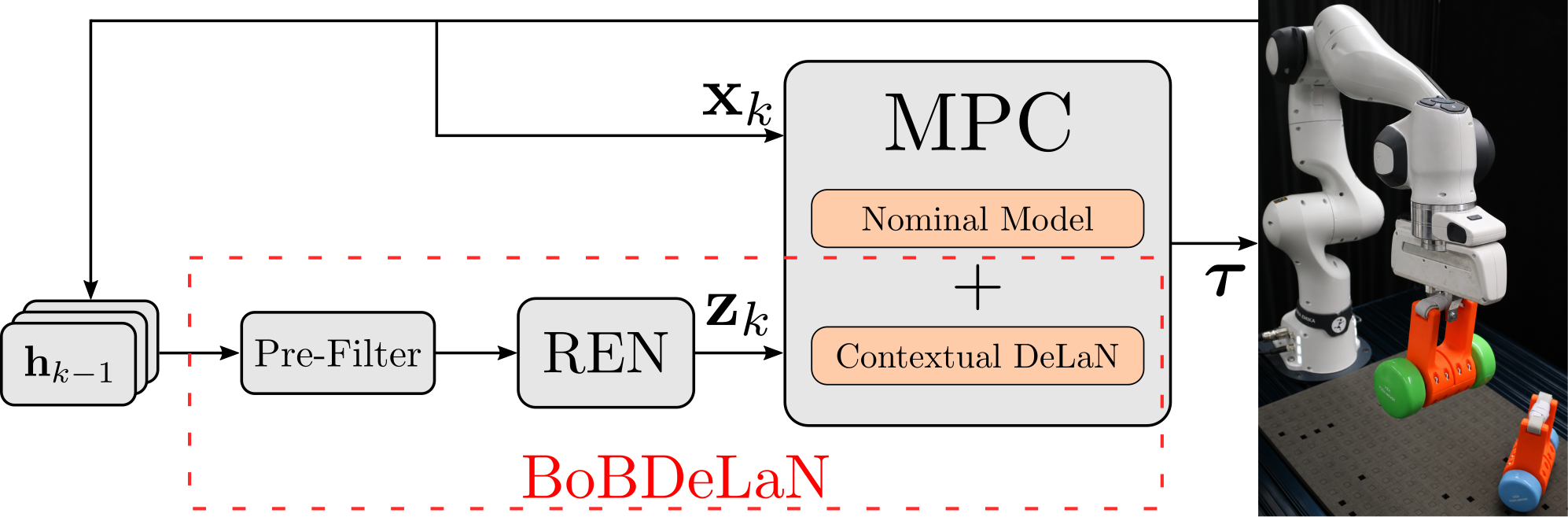
BoBDeLaN architecture: a filtered measurement history is encoded by a REN into a context that conditions the Contextual DeLaN model used within MPC.
Overview
Context-Aware Deep Lagrangian Networks adapt to unknown payloads by inferring a latent context from measurement histories. However, the LSTM encoder they rely on provides no guarantees on sensitivity to measurement disturbances. BoBDeLaN addresses this limitation by combining a contracting, gain-bounded Recurrent Equilibrium Network (REN) with stable linear filtering, enabling frequency-shaped disturbance sensitivity while preserving the Lagrangian structure.
Theoretical guarantees
Exponential forgetting of recurrent initial states and frequency-weighted bounds on context and residual torque prediction sensitivity.
Frequency-shaped adaptation
Reduced high-frequency sensitivity compared to an LSTM encoder using the same input filter.
Improved dynamics prediction
Lower residual torque prediction errors and smoother control across simulated payload variations.
Robust hardware control
Real-world pick-and-place experiments demonstrate substantially less performance degradation under injected disturbances compared to the LSTM baseline.
Real Hardware Experiments
Adaptive Control with Changing Payloads
We compare nominal MPC, CaDeLaC with an LSTM encoder, and CaDeLaC with BoBDeLaN on a real Franka Panda performing a pick-and-place task with changing payloads. Both learned controllers improve dynamics prediction, while BoBDeLaN achieves smoother motion and lower residual torque prediction errors.
Adaptive Control with Changing Payloads under Disturbances
We repeat the experiment with injected 5 Hz and 10 Hz disturbances in the encoder's torque measurements. While the CaDeLaC LSTM exhibits substantially degraded tracking and oscillatory motion, BoBDeLaN maintains smoother and more robust control.
CaDeLaC BoBDeLaN: With and Without Disturbances
We compare BoBDeLaN with and without injected measurement disturbances. Its gain-bounded recurrent encoder and low-pass filtering limit the effect of disturbances, resulting in only small degradation in tracking and motion smoothness.
CaDeLaC LSTM: With and Without Disturbances
We compare the original CaDeLaC LSTM with and without the same injected disturbances. Despite using identical input filtering, the LSTM encoder exhibits substantially increased sensitivity, leading to larger tracking errors and more oscillatory motion.
Citation
If you find this work useful, please consider citing:
@misc{schulze2026bobdelanboundedbandwidthcontextadaptation,
      title={BoBDeLaN: Bounded-Bandwidth Context Adaptation for Deep Lagrangian Robot Control},
      author={Lucas Schulze and Sucheth Shenoy and Jan Peters and Oleg Arenz},
      year={2026},
      eprint={2611.21209},
      archivePrefix={arXiv},
      primaryClass={cs.RO},
      url={https://arxiv.org/abs/2611.21209},
}
Acknowledgment
This work was funded by the German Research Foundation (DFG) - Project number PE 2315/18-1, and by the German Federal Ministry of Research, Technology and Space (BMFTR) - Project number 01IS23057B, and as part of the Robotics Institute Germany (RIG). This project has been supported by a hardware donation by NVIDIA through the Academic Grant Program.